When Should You Choose a Ceiling Cassette Air Conditioner and When Should You Choose a Wall-Mounted Unit?
Choosing between a ceiling cassette air conditioner and a wall-mounted air conditioner is not simply a matter of deciding which system looks better. The two indoor unit designs can provide excellent cooling and heating, but they behave differently in terms of airflow distribution, installation requirements, maintenance access, room layout and overall cost.
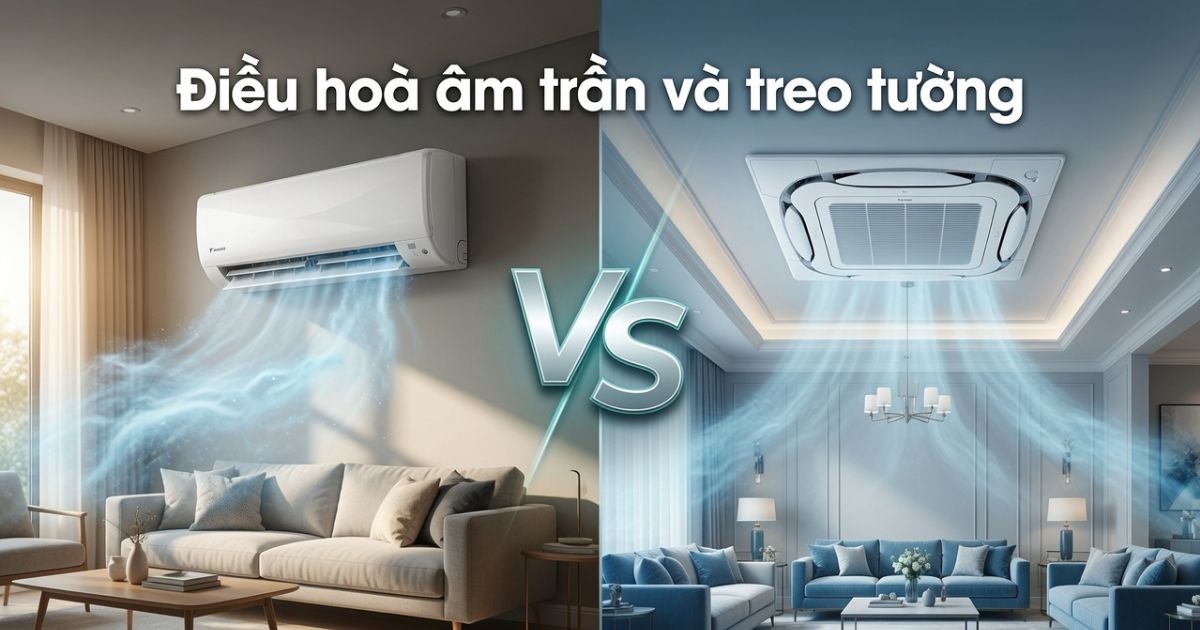
A ceiling cassette is generally designed to sit within or against the ceiling and distribute air across the room, with four-way models capable of directing air in multiple directions. Mitsubishi Electric, for example, describes its four-way cassette systems as providing customizable airflow patterns through multiple directional vanes.
A wall-mounted split air conditioner, by comparison, is installed high on a wall and sends conditioned air outward into the room. It is usually simpler to install and maintain, making it a very practical option for bedrooms, offices and smaller rooms.
So, when should you choose a ceiling cassette, and when is a wall-mounted air conditioner the better choice?
The answer depends primarily on the room rather than the air conditioner itself.
Table of Contents
Ceiling Cassette vs. Wall-Mounted Air Conditioner at a Glance
| Factor | Ceiling Cassette | Wall-Mounted |
|---|---|---|
| Installation | More complex | Simpler |
| Appearance | Discreet, ceiling-integrated | Visible on the wall |
| Air distribution | Excellent for multi-directional airflow | Directional airflow |
| Wall space | Almost completely preserved | Requires wall space |
| Ceiling requirements | Important | Minimal |
| Maintenance access | Can be more difficult | Generally easier |
| Installation cost | Usually higher | Usually lower |
| Best for | Open rooms, offices, restaurants, commercial spaces | Bedrooms, small rooms, homes, offices |
| Furniture restrictions | Can be advantageous | Unit location must be considered |
| Retrofit projects | Depends on ceiling access | Usually easier |
| Aesthetic priority | Excellent | Good, but more visible |
There is no universal winner. The right choice depends on the physical structure of the room, the desired airflow pattern, the available installation space and the budget.
When Should You Choose a Ceiling Cassette Air Conditioner?
1. Choose a Ceiling Cassette When You Want Airflow in Multiple Directions
One of the biggest advantages of a four-way ceiling cassette is airflow distribution.
Instead of mounting the indoor unit on one side of the room and directing air across the space, a four-way cassette can distribute air in several directions from the ceiling.
Mitsubishi Electric states that its four-way ceiling cassette systems can use multiple independently adjustable vanes and offer numerous airflow configurations.
This can be particularly useful in a relatively square or open room where occupants are distributed around the entire space.
For example, consider a 40 to 60 square metre office containing several desks. A wall-mounted unit placed at one end of the room may have to throw air across the entire space. A ceiling cassette positioned closer to the center can distribute air outward.
That does not automatically mean a cassette will always cool the room faster. Correct sizing, installation and airflow design remain critical.
However, the physical arrangement of the cassette gives the designer more flexibility when the room is open and occupied across a large area.
2. Choose a Ceiling Cassette When Wall Space Is Limited
Another strong reason to consider a ceiling cassette is a lack of suitable wall space.
Modern rooms often have walls occupied by windows, cabinets, shelving, televisions, artwork, doors or other equipment.
In such situations, finding a good position for a high-wall indoor unit can become difficult.
A ceiling cassette moves the indoor unit away from the wall and into the ceiling plane.
This is one reason ceiling-mounted systems are commonly considered for commercial interiors, offices, retail spaces and restaurants.
Daikin, for example, offers several indoor-unit configurations for commercial systems, including round-flow ceiling cassettes, wall-mounted units, concealed ducted units and ceiling-suspended units, reflecting the fact that different room layouts require different indoor-unit arrangements.
3. Choose a Ceiling Cassette When Appearance Is a Major Concern
A wall-mounted mini-split is highly visible.
Even modern units have a recognizable rectangular indoor unit mounted near the top of the wall.
Some homeowners simply do not like that appearance.
A ceiling cassette can provide a more integrated appearance because most of the indoor unit is recessed above the ceiling, leaving primarily the grille visible.
Mitsubishi Electric specifically promotes the flush-mounted appearance of its ceiling-recessed systems as a way to integrate the air conditioner into the room without visually dominating the décor.
This can be particularly attractive in:
-
Modern homes
-
High-end apartments
-
Hotels
-
Restaurants
-
Meeting rooms
-
Showrooms
-
Retail stores
-
Offices
For architects and interior designers, this aesthetic advantage can be more important than the additional installation complexity.
4. Choose a Ceiling Cassette for Open-Plan Rooms
Open-plan rooms are one of the strongest applications for a four-way ceiling cassette.
Imagine a restaurant with tables distributed throughout the room. A wall-mounted unit positioned at one end has to distribute air over a long distance.
A ceiling cassette installed in an appropriate location can distribute air around the occupied zone.
The same principle can apply to offices, classrooms and retail environments.
Daikin specifically identifies its round-flow cassette as suitable for open-plan applications such as classrooms and offices.
However, the size and shape of the room still matter. A long, narrow room may sometimes be better served by a one-way cassette, wall-mounted unit or another indoor-unit configuration rather than automatically selecting a four-way cassette.
When Should You Choose a Wall-Mounted Air Conditioner?
1. Choose a Wall-Mounted Unit When Installation Simplicity Matters
For many residential applications, the wall-mounted system is the practical choice.
The indoor unit can be mounted high on a suitable wall, with the refrigerant lines, drain and electrical connections routed through the wall toward the outdoor unit.
This generally makes the installation less complicated than cutting and reinforcing a ceiling for a recessed cassette.
The difference becomes especially important in an existing house where the ceiling is already finished.
A ceiling cassette may require access above the ceiling, suitable framing, drainage planning and sufficient clearance.
A wall-mounted system usually avoids much of that work.
This is also reflected in overseas HVAC discussions. In a Reddit discussion comparing ceiling cassettes and wall-mounted mini-splits, one owner described wall-mounted mini-splits as attractive because of their “simplicity of installation, cost of installation” and flexibility.
That is not a laboratory performance measurement, but it reflects an important real-world consideration: installation complexity affects the total cost and future serviceability of the system.
2. Choose a Wall-Mounted Unit for Bedrooms
For a typical bedroom, a wall-mounted air conditioner is often the more straightforward choice.
A bedroom generally has a relatively simple layout and does not require air distribution in four directions.
The unit can be installed high on a wall and directed across the room.
There is also usually less reason to cut into the ceiling simply for aesthetic purposes.
One Reddit discussion about ceiling cassettes versus wall-mounted systems included users who chose wall-mounted units for bedrooms because they found the installation simpler and considered the airflow adequate for the space.
However, positioning remains important.
A wall-mounted unit should not simply be installed wherever there is an empty wall. The installer should consider the bed position, occupants, airflow direction, return-air path, windows, doors and furniture.
Direct airflow toward a person for long periods may be uncomfortable even if the room temperature is technically correct.
3. Choose a Wall-Mounted Unit When the Ceiling Cannot Accommodate a Cassette
This is one of the most important practical considerations.
A ceiling cassette needs an appropriate ceiling structure.
A conventional recessed cassette is not simply a wall-mounted unit turned sideways.
A Reddit HVAC discussion about installing a cassette on a sloped ceiling illustrates the issue. Experienced commenters pointed out that standard ceiling cassettes are designed to be installed level, and that a pitched ceiling can make them unsuitable.
Another discussion also noted that cassette installation requires consideration of the ceiling framing and drainage arrangement.
Therefore, if the room has:
-
A very low ceiling
-
A steeply pitched ceiling
-
Limited ceiling cavity
-
Difficult structural framing
-
No practical access above the ceiling
-
A finished ceiling that the owner does not want to open
a wall-mounted system may be the much more sensible solution.
4. Choose a Wall-Mounted Unit When Budget Is Important
The indoor unit itself is only part of the total cost.
Installation is another major component.
A ceiling cassette can require additional ceiling work, structural support, condensate drainage and more complicated refrigerant-line routing.
Wall-mounted systems generally require less modification to the building.
A 2026 comparison from AC Direct similarly identifies wall-mounted systems as easier to install, while ceiling cassettes generally involve more complicated installation and ceiling access.
This is particularly important for a small residential room.
If a 15 to 25 square metre bedroom already has a perfectly usable wall position, paying substantially more to recess an indoor unit into the ceiling may provide little practical benefit.
In that situation, a good-quality wall-mounted inverter may be the better investment.
What Do Overseas HVAC Users Say?
Manufacturer specifications tell us what a system is designed to do. Owner forums tell us what people experience after living with the equipment.
The overseas discussions are interesting because they do not produce a simple consensus that ceiling cassettes are better.
In one Reddit discussion, an owner who had installed both wall-mounted and cassette units reported that there was “basically no difference” in functionality, while choosing cassettes primarily for appearance.
That is an important observation.
The cassette’s biggest advantage may not always be dramatically better cooling performance. In many applications, its biggest advantages are:
-
Air distribution
-
Appearance
-
Preserving wall space
-
Suitability for open-plan rooms
Another Reddit user who had considered cassettes for several bedrooms ultimately described wall-mounted mini-splits as attractive because of installation simplicity and cost.
There are also positive reports about cassette reliability. In a Garage Journal discussion, one owner reported having four LG 12,000 BTU ceiling cassettes operating for eight years. At the same time, that user mentioned disadvantages such as the physical size of the cassette and the use of a condensate pump.
This highlights an important point: ceiling cassettes are not inherently unreliable. But their installation and drainage systems can be more complicated than a simple high-wall unit.
Ceiling Cassette Maintenance vs. Wall-Mounted Maintenance
Maintenance is another area where the difference becomes noticeable.
A wall-mounted indoor unit is normally located at a reachable height. Filters can often be removed from the front panel and cleaned relatively easily.
A ceiling cassette is installed overhead.
Even if filter access is designed to be convenient, a technician or homeowner may need a ladder or other safe access equipment.
Some forum users have specifically raised concerns about service access and condensate pumps when comparing cassette systems with wall-mounted systems.
This does not make a cassette a bad choice. It simply means maintenance access should be considered before installation.
For a commercial building with professional maintenance staff, this may not be a major issue.
For a homeowner who wants to clean the filter every few weeks without using a ladder, a wall-mounted unit may be more convenient.
What About Condensate Drainage?
Condensate drainage deserves special attention.
A wall-mounted split unit can often use gravity drainage, depending on the installation layout.
A ceiling cassette may require a condensate pump because the indoor unit is positioned within the ceiling and the drain cannot always achieve a suitable natural slope.
One long-term user on Garage Journal specifically mentioned that their LG ceiling cassettes used a pump to remove condensate rather than relying on gravity drainage.
That means the installer should plan:
-
Condensate drain routing
-
Drain slope where possible
-
Pump access
-
Service access
-
Overflow protection
-
Future maintenance
Poor drainage design can create water leakage problems regardless of how expensive the air conditioner is.
Therefore, a ceiling cassette should not be selected purely because it looks better.
Which One Provides Better Airflow?
The answer depends on the room.
A four-way cassette has an inherent advantage when the objective is to distribute air around a central point.
Mitsubishi Electric states that its four-way cassette systems can independently configure multiple airflow vanes, providing many airflow patterns.
A wall-mounted unit, however, can also distribute air very effectively when correctly positioned.
In some rooms, a high-wall unit can throw air across the room and use automatic horizontal and vertical swing to improve distribution.
One overseas homeowner discussion specifically described wall-mounted units as being able to distribute air across a room effectively, even though the user initially preferred cassettes for aesthetic reasons.
Therefore, it would be misleading to say:
“Ceiling cassette = better cooling.”
A more accurate statement is:
“Ceiling cassette = potentially better air distribution for certain room layouts.”
The actual cooling performance still depends on capacity, inverter control, heat load, insulation, outdoor temperature, installation quality and airflow design.
Ceiling Cassette or Wall-Mounted: Which Is Better for Different Rooms?
| Room / Application | Recommended Choice | Reason |
|---|---|---|
| Small bedroom | Wall-mounted | Simple and cost-effective |
| Children’s bedroom | Wall-mounted | Easy maintenance and control |
| Home office | Wall-mounted | Usually sufficient |
| Living room | Either | Depends on layout |
| Large open living room | Ceiling cassette | Better multi-directional distribution |
| Restaurant | Ceiling cassette | Preserves wall space |
| Retail store | Ceiling cassette | Better integration with interior |
| Classroom | Ceiling cassette | Suitable for open-plan distribution |
| Small office | Wall-mounted or cassette | Depends on layout |
| Large office | Ceiling cassette | Better zoning and distribution |
| Hotel room | Wall-mounted or concealed type | Depends on design |
| Modern luxury interior | Ceiling cassette | Cleaner visual appearance |
| Low ceiling | Wall-mounted | Easier installation |
| Sloped ceiling | Wall-mounted | Standard cassette may not be suitable |
| Existing finished ceiling | Wall-mounted | Less structural modification |
| Budget-conscious project | Wall-mounted | Generally simpler installation |
The Most Important Question: What Is Your Room Like?
Instead of starting with the question:
“Which air conditioner is better?”
start with:
“What does my room require?”
If you have a square open-plan room, limited wall space and a suspended or suitable ceiling, a ceiling cassette can be an excellent solution.
If you have a conventional bedroom with a suitable exterior wall and a limited installation budget, a wall-mounted unit is usually more practical.
If your ceiling is difficult to access, a wall-mounted system may save considerable installation work.
If appearance is a major design consideration and the ceiling structure supports a cassette, the recessed unit can produce a much cleaner interior.
Final Verdict: When Should You Choose Each Type?
A ceiling cassette air conditioner is generally the better choice when the room is open, the ceiling can accommodate the unit, wall space is limited and multi-directional airflow or interior aesthetics are important.
A wall-mounted air conditioner is generally the better choice when installation simplicity, lower installation cost, easy maintenance and flexibility are more important.
The overseas HVAC community does not appear to support the idea that one configuration is universally superior. Discussions on Reddit and other forums repeatedly come back to the same practical conclusion: the room layout and installation conditions should determine the indoor-unit type.
For residential bedrooms and smaller rooms, a wall-mounted unit is often the most economical and practical option.
For larger open-plan spaces, restaurants, offices, classrooms and commercial interiors, a ceiling cassette becomes more attractive because it can distribute air from the ceiling while preserving wall space.
Ultimately, the best air conditioner is not necessarily the one with the most sophisticated indoor unit. It is the system whose capacity, airflow, installation position, drainage and maintenance requirements are correctly matched to the building.
In short:
Choose a ceiling cassette when you need better multi-directional air distribution, a cleaner ceiling-integrated appearance and more freedom from wall-mounted equipment.
Choose a wall-mounted unit when you want simpler installation, easier maintenance, lower installation complexity and a practical solution for bedrooms and conventional rooms.